Target guide · globular cluster
M9 with a smart telescope
M9 is a globular cluster about 9 arcminutes (0.15°) across, magnitude 7.9. It is highest around midnight in June, best placed for the southern hemisphere, and bright enough to image from a suburb or even a city. Of the 16 smart telescopes we track, Odyssey, Odyssey Pro, eQuinox 2 frame it best.
Key facts
| Catalogue | M9 · NGC 6333 |
|---|---|
| Type | globular cluster |
| Apparent size | 9′ × 9′ |
| Magnitude | 7.9 |
| Position (J2000) | RA 17.32 h, Dec -18.5° |
| Highest at midnight | June (±2 weeks) |
| Sky needed | City-friendly |
Simulated stack
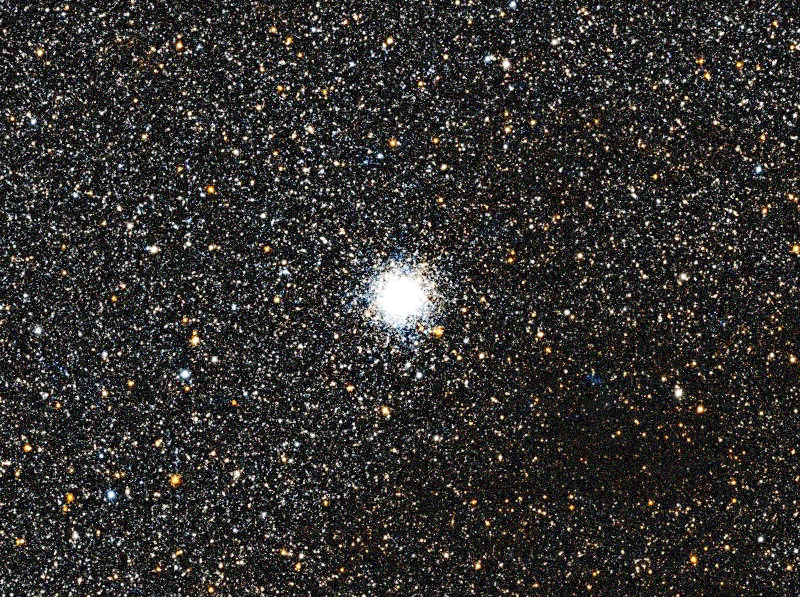
No survey image is available here. The diagram below still shows the object’s size within the frame.
Selected telescope’s field of view
Real user photos of M9
No approved photos of M9 yet. Be the first to share yours.
Imaging tips
Globular clusters are bright and compact. Short sessions already give a good result from town; a narrower field of view shows more individual stars in the core. M9 is one of the easier targets from light-polluted skies.
Which smart telescope frames it best
| Telescope | Field of view | Fit | Mosaic |
|---|---|---|---|
| Unistellar Odyssey | 0.75° × 0.56° | fits well | one frame |
| Unistellar Odyssey Pro | 0.75° × 0.56° | fits well | one frame |
| Unistellar eQuinox 2 | 0.76° × 0.57° | fits well | one frame |
| Unistellar eVscope 2 | 0.76° × 0.57° | fits well | one frame |
| ZWO Seestar S50 | 1.29° × 0.73° | fits well | one frame |
| Celestron Origin Mark II | 1.32° × 0.75° | small in the frame | one frame |
| Vaonis Atlas | 1.78° × 1° | small in the frame | one frame |
| DWARFLAB DWARF mini | 2.13° × 1.2° | small in the frame | one frame |
| ZWO Seestar S30 | 2.14° × 1.21° | small in the frame | one frame |
| DWARFLAB Draco | 1.649° × 1.238° | small in the frame | one frame |
| ZWO Seestar S50 Pro | 2.45° × 1.38° | small in the frame | one frame |
| Vaonis Vespera II | 2.5° × 1.4° | small in the frame | one frame |
| Vaonis Vespera 3 | 2.5° × 1.4° | small in the frame | one frame |
| Vaonis Vespera Pro 2 | 1.6° × 1.6° | small in the frame | one frame |
| DWARFLAB DWARF 3 | 2.93° × 1.65° | small in the frame | one frame |
| ZWO Seestar S30 Pro | 3.99° × 2.24° | small in the frame | one frame |
How high it gets from where you live
Highest altitude above a flat horizon. Below about 20° the image suffers from haze and light pollution; trees and roofs often block it completely.
| Latitude | Highest altitude |
|---|---|
| Oslo, 60° N | 11° |
| Amsterdam, 52° N | 19° |
| Madrid, 40° N | 31° |
| Miami, 26° N | 45° |
| Equator | 71° |
| Sydney, 34° S | 75° |
Nearby in the sky
Objects close to M9 in the sky, so you can image them in the same session.
Questions and answers
- Can I photograph M9 from a city?
- Yes. It is bright enough to image from a suburb or even a city.
- Which smart telescope is best for M9?
- Odyssey, Odyssey Pro, eQuinox 2 fit it best in a single frame, judging by its size and each telescope's field of view.
- When is the best time to photograph M9?
- It is highest around midnight in June and best placed for the southern hemisphere. From 52° north it climbs to about 19° at most.