Target guide · spiral galaxy
M77 Cetus A with a smart telescope
M77 Cetus A is a spiral galaxy about 7 arcminutes (0.12°) across, magnitude 8.8. It is highest around midnight in October, well placed from both hemispheres, and works from a suburb; a darker site gives a much cleaner result. Of the 16 smart telescopes we track, Odyssey, Odyssey Pro, eQuinox 2 frame it best.
Key facts
| Catalogue | M77 · NGC 1068 · PGC 10266 · UGC 2188 |
|---|---|
| Type | spiral galaxy |
| Apparent size | 7′ × 6′ |
| Magnitude | 8.8 |
| Position (J2000) | RA 2.71 h, Dec -0.0° |
| Highest at midnight | October (±2 weeks) |
| Sky needed | Suburban sky |
Simulated stack
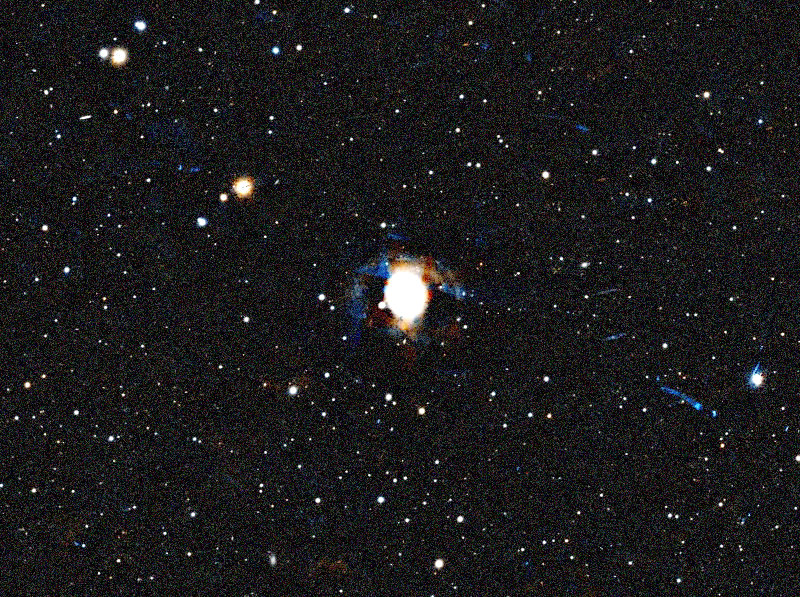
No survey image is available here. The diagram below still shows the object’s size within the frame.
Selected telescope’s field of view
Real user photos of M77 Cetus A
No approved photos of M77 Cetus A yet. Be the first to share yours.
Imaging tips
Galaxies shine in broad starlight, so light-pollution filters help little. What helps most is a darker site and a long total exposure. Plan on one to three hours of stacking for the faint outer parts. Cetus A is a reasonable target from the suburbs.
Which smart telescope frames it best
| Telescope | Field of view | Fit | Mosaic |
|---|---|---|---|
| Unistellar Odyssey | 0.75° × 0.56° | fits well | one frame |
| Unistellar Odyssey Pro | 0.75° × 0.56° | fits well | one frame |
| Unistellar eQuinox 2 | 0.76° × 0.57° | fits well | one frame |
| Unistellar eVscope 2 | 0.76° × 0.57° | fits well | one frame |
| ZWO Seestar S50 | 1.29° × 0.73° | small in the frame | one frame |
| Celestron Origin Mark II | 1.32° × 0.75° | small in the frame | one frame |
| Vaonis Atlas | 1.78° × 1° | small in the frame | one frame |
| DWARFLAB DWARF mini | 2.13° × 1.2° | small in the frame | one frame |
| ZWO Seestar S30 | 2.14° × 1.21° | small in the frame | one frame |
| DWARFLAB Draco | 1.649° × 1.238° | small in the frame | one frame |
| ZWO Seestar S50 Pro | 2.45° × 1.38° | small in the frame | one frame |
| Vaonis Vespera II | 2.5° × 1.4° | small in the frame | one frame |
| Vaonis Vespera 3 | 2.5° × 1.4° | small in the frame | one frame |
| Vaonis Vespera Pro 2 | 1.6° × 1.6° | small in the frame | one frame |
| DWARFLAB DWARF 3 | 2.93° × 1.65° | small in the frame | one frame |
| ZWO Seestar S30 Pro | 3.99° × 2.24° | small in the frame | one frame |
How high it gets from where you live
Highest altitude above a flat horizon. Below about 20° the image suffers from haze and light pollution; trees and roofs often block it completely.
| Latitude | Highest altitude |
|---|---|
| Oslo, 60° N | 30° |
| Amsterdam, 52° N | 38° |
| Madrid, 40° N | 50° |
| Miami, 26° N | 64° |
| Equator | 90° |
| Sydney, 34° S | 56° |
Nearby in the sky
Objects close to M77 in the sky, so you can image them in the same session.
- M74 Phantom Galaxy
- M45 Pleiades
- NGC 1333 Embryo Nebula
- M33 Triangulum Galaxy
- IC 2118 Witch Head Nebula
- NGC 253 Sculptor Galaxy
Questions and answers
- Can I photograph M77 Cetus A from a city?
- It is possible. It works from a suburb; a darker site gives a much cleaner result.
- Which smart telescope is best for M77 Cetus A?
- Odyssey, Odyssey Pro, eQuinox 2 fit it best in a single frame, judging by its size and each telescope's field of view.
- When is the best time to photograph M77 Cetus A?
- It is highest around midnight in October and well placed from both hemispheres. From 52° north it climbs to about 38° at most.